
At Kata-Kata カタカタ, the Malaysian Architecture Week exhibition in Tokyo, every architect begins with words before showing a single form. This is the story of one Malaysian architect, PAB Architecture’s Director, Ar. David Teoh: where he comes from, how he grew up and what made him an architect, in his own words.
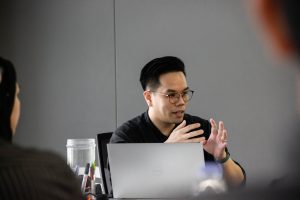
Malaysian architect David Teoh leading an internal training session for PAB Architecture
Born in George Town, raised in Subang Jaya
I was born in George Town, Penang. My family had been living in Hong Kong, where my father was working, and shortly after my birth we returned there for another two years, in that dense, vertical city. We later settled in Subang Jaya, a new township built on former oil palm estate land. At the time, it was one of the best master-planned housing developments in the country: a plantation landscape remade into a suburb for a new Malaysian middle class.
A community for every Malaysian
My friends came from every community. Their parents, like mine, had come from across the country to put down roots in a new township, against the backdrop of an industrialising Malaysia in the Look East years, when the nation set out to learn from Japan. Our diversity taught me patience, cultural sensitivity and respect, and to advocate for what is right strategically rather than impulsively. These are architectural virtues as much as civic ones: an architect, too, must listen across differences of opinion before drawing a line.
Many forces could easily separate us and tear us apart, but I am an optimist. I am incredibly proud of our underlying culture of making concessions, acknowledging others, demonstrating acceptance and embracing our differences. I hope this will count towards our resilience in an increasingly turbulent world.
A dream of a pyramid: deciding to become an architect
All around me, Malaysia was rapidly developing, and I was constantly impressed by what it built: Ken Yeang’s Menara Mesiniaga in Subang Jaya, a futuristic model for the bioclimatic skyscraper; the Petronas Towers; Hijjas Kasturi’s many skyscrapers; and Kisho Kurokawa’s KLIA, an airport set within a forest. It was an architecture of national optimism, and I grew up inside it.
Around the time I had to choose my university course, I had a vivid dream. I was working in a skyscraper office, reviewing drawings and models, and out of the window stood a distinct pyramid-shaped tower. When I told my father, he took me to see an uncle who was an architect, to find out whether the profession was truly for me. My uncle tried to talk me out of it, but as we left he handed me a few books. On the cover of the very first was the Transamerica Pyramid in San Francisco: the exact building from my dream.
Studying architecture in Melbourne
I studied architecture at the University of Melbourne, and my work still carries what I learnt in Australia. Haig Beck’s formal instruction gave me my sense of proportion, of classically inspired order, and of the balance between mass and lightness. My final-year project, Tiny Tower, taught me the fundamentals: tectonics, sensitivity to place, designing for a warm and wet climate, and the basics of timber construction. It also gave me the idea I still work with: sticks and stones. Light timber shelter opens to the weather, while heavy, grounded rooms hold against it. Much of my work since has been a negotiation between the two.
That final year was not easy. I had to move house in the same week as my final thesis, and my friends carried me through it. We then graduated in 2008, straight into a global recession, with no certainty of finding work. Those friendships, and that uncertainty, taught me as much as any studio.
After graduating, I worked as a research assistant to Professor Paolo Tombesi on Australian Parliament House, which took me to Canberra and into the work of its architect, Romaldo Giurgola, whom I remember fondly. Parliament House showed me that a public building can be intrinsically classical, carrying weight, proportion and permanence, and still feel entirely of its time. That lesson later guided our competition-winning design for the Embassy of the State of Kuwait.
Five years at COX Architecture in Melbourne, and the friends I made there early in my career, then shaped my design aesthetic and my approach to structural expression.
Returning to Malaysia: building in the tropics
I returned to Malaysia and joined PAB in 2013, hoping that the country was entering a period of transformation, and believing that Asia was the place to be for the next half-century. Here, the local context and the tropics demanded a specific response.
Our condition is the one Rem Koolhaas described in “Singapore Songlines”: a society remaking itself within a single generation, under intense pressure to modernise. Malaysia has developed at a similar pace, and our challenge has been to reconcile a contemporary tropical regionalism with the aspirations of a population exposed to globalisation. In such a context, I believe our strongest unifying identity lies not in a shared style, but in individual architects, each expressing themselves through the same problem: how to build in the tropics.
Healthier Ecologies: rethinking PAB
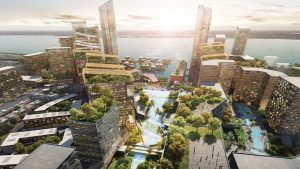
I became a Director of PAB in 2021. Coming out of the pandemic, we had the chance to rethink the practice from first principles. We asked why PAB exists, and found the answer in our own name, Perunding Alam Bina. Alam bina means the built environment, or, as I like to read it, built ecologies. That became our mission, Healthier Ecologies: designing places that enhance health for the people who use them and the ecosystems that support them.
To deliver it, we chose to work as one transdisciplinary team. Architects, health facility planners, town planners, landscape architects and interior designers share the design table from the start, rather than passing a project from one discipline to the next. I first set out this way of working in a talk, Evolution & Renewal, at PAM’s POP Workshop in 2022, and it now shapes every project we take on.
Generosity as an approach
In a practice whose work is mostly public healthcare, delivered on tight budgets, I have struggled constantly with how to deliver more with less. Generosity became my answer as a designer: making do with very few resources to deliver something of real impact.
Four projects trace that line of thought:
- Tiny Tower (North Stradbroke Island, Queensland, 2008; People’s Choice Award, Glenn Murcutt Student Prize). Where sticks and stones began.
- Embassy of the State of Kuwait (Putrajaya; competition winner, unbuilt). A chancery of mass and classical order learnt from the Australian Parliament House, recalling the souq and Kuwaiti masonry.
- The Graph Hotel (Cheras, Kuala Lumpur, 2025). My first hotel, resolving architecture and interiors together on a tight budget. It taught me that generosity in architecture is not a matter of cost. It is a matter of care.
- Antara アンタラ (2023, unbuilt). An exercise in tropicality: an expansive roof with an impossibly thin edge, and a second roof beneath it that the rain demanded. It is the work exhibited in Tokyo.

Why architects should write
As Editor-in-Chief of Architecture Malaysia, I believe Malaysian architects need to write, document and communicate their work better. The magazine, and the online portal we launched in 2025, are opportunities to bring our work to a wider audience. But writing is also an internal discipline: putting a building into words helps us understand our own process and method.
Advice for architecture students
Architects have to be continuously curious about how things work and how everything is put together. Learn by sketching, by touching materials and by experiencing buildings for yourself. And travel as much as you can: there is so much to learn, and the world is our classroom.
See Antara in Tokyo
Antara is on show at Kata-Kata at KOCA in Kamata, Tokyo, from 6 to 11 November 2026, as part of Malaysian Architecture Week. Read more about the project and the exhibition in our post Kata-Kata カタカタ: Tropical Malaysian Architecture Comes to Tokyo [link].
Work with us
Planning a healthcare, public or civic project? PAB’s transdisciplinary team of architects, health facility planners, town planners, landscape architects and interior designers would be glad to talk. Get in touch with us.
About Ar. David Teoh
Ar. David Teoh Wui Leng is a Director of PAB Architecture, a Kuala Lumpur practice established in 1974 with the mission of Healthier Ecologies. He is Editor-in-Chief of Architecture Malaysia and Honorary Secretary of the Malaysian Institute of Architects (PAM), which named him one of its 40 Under 40 Emerging Architects in 2023. In 2026 he served on the juries of the INDE.Awards, the FIABCI Malaysia Property Award and the Malaysian Landscape Architecture Awards (MLAA).